Friday, October 2, 2020

Honoring A Pacific Island missionary from the Past: The Reverend Paula Seru


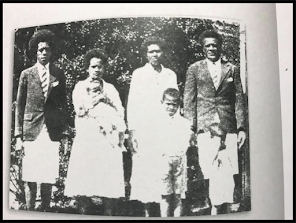
In the previous blog, I honoured Waqa Baravilala. In this blog, I honour his great-grandfather, the Reverend Paula Seru. There is not much detail about his life, but there is enough to remember him by. Reverend Seru was one of the first Fijian missionaries to Milingimbi Island, in the Northern Territories, Australia, the second of five mission stations established by the Methodist Overseas Mission (MOM). 

Between 1928 and 1950, seven Pacific Islanders, predominantly Fijians, were employed in Arnhem Land. Paula Seru (1928-1936), llaijia Seru (1928-1930), Kolinio Naulago Saukuru (1933- 1948), Verencki Veitarogivanua (1937-1942) and Meli Tukai (1937-1944).

.   .   

Although the Fijians were initially recruited to provideAlthough the Fijians were initially recruited to provide instruction to the Aboriginal people in the basics of agriculture, they also demonstrated their versatility, functioning in a range of jobs such as "builders, captains of mission vessels, Sunday school teachers, choir masters, evangelists, pastors, and 'protectors' of Aboriginal people" (Kadiba, 1998:107).

Paula, a lay missionary, along with others was involved in teaching the Aborigines how to utilise the land and resources for sustainability, including how to cultivate crops and vegetables. The Fijians served as a bridge between the aboriginals and the Caucasion missionaries. In his thesis, "The Methodist Mission and the emerging Aboriginal Church in Arnhem Land 1916-1977," Kadiba notes that "when their white missionary counterparts were on furlough or on sick leave, the Fijian missionaries single-handedly took responsibility for looking after the mission establishments" and were "valuable assets" during the war years. MOM records and other writings often expressed praise for the Fijian missionaries and noted that they were respected by the Aboriginals.

Waqa had the great privilege to visit the island of Millingimbi many years after his great-grandfather’s arrival. In 2019, he along with his father and family members visited for the first time.

“After learning about my mission heritage, I had total confidence in God’s call to commit my life to mission ministry. My Great Grandfather’s life impacted me and I am glad to be serving in Australia as he was, because of God’s call." 

Waqa Barvavilala


Information taken primarily from pages 103-109: Kadiba, John. "The Methodist Mission and the emerging Aboriginal Church in Arnhem Land 1916-1977." Thesis submitted for Doctor of Philosophy through the Faculty of Education, Northern Territory University, 1998.

Sunday, September 6, 2020

Honoring Fijian Missionary Soane Waqabaca Baravilala (Waqa)


Waqa was born on March 1st, 1971. His father Iliesa Baravilala is from Naqalotu and Yawe Kadavu. His mother, Neomai Sega (deceased), was from Ogea Lau. Waqa grew up in Vuma Village, Levuka.  

Waqa married Jade Alexandra Baravilala, a woman of Greek, Russian and Australian descent in October 2000.  Besides being a wife and busy mum, Jade studied Counseling and Family Therapy at the Australia Institute of Family Counselling.  She also has a degree in Business and Sports management. Jade teaches on Discipleship and Counselling.

 Their children are Napolioni Seru, an 18-year-old and budding missionary with  Island Breeze in Busan Korea; Lagakali Sophia (16), Iliesa Williams Tuibua (14), Rupeni Koto (12), Ieru Pa’ala Gailnya (deceased) and Ratu Jope Sigaruarua Galinya (almost 2). 

Waqa became a born again Christian on December 25, 1989, in his small Methodist Church in Vuma Village, Ovalau. Shortly thereafter, he attended a Youth With A Mission (YWAM) conference in Fiji. Even though he had no idea about the organisation, the stories and testimonies from the YWAM missionaries impacted him greatly. In 1990 he attended a Discipleship Training School (DTS) in YWAM Nadi and is still with YWAM today. 

During his DTS in Nadi, Waqa received a call to missions. He took more courses at YWAM’s University of The Nations and these equipped him for the call to reach nations. He graduated with an Associate of Arts degree in Biblical Studies. 

He first served the Lord with YWAM for 10 years in both Fiji and Tonga, then moved to Australia to join Island Breeze there. He and his family have been with that ministry for the last 20 years.


Waqa has remained in missions for 30 years, serving specifically with the Island Breeze Ministry since 1994, a role that came about after he attended the Principles of Redeeming Cultures School (PRCS) in Tonga. Waqa and Jade began leading a YWAM base in Carbrook, Brisbane in 2003 and pioneered a new YWAM program called Island Breeze Rugby Plus (Facebook). Within the Rugby Plus ministries, DTS students have hailed from nations such as Fiji, Samoa, Australia, Vanuatu, France, Japan, Papua N Guinea (PNG), Brisbane, USA, New Zealand, and Tonga. Over the past few years, outreaches from teams in these nations have gone to Japan, Fiji, Thailand, Singapore, Malaysia, Cambodia, PNG, Vanuatu, Samoa, New Caledonia, the Solomon Islands, and within Australia, visits to many Indigenous aborigine communities. Waqa and staff have run around 15 Rugby DTS programs and continue to partner with YWAM in Samoa, Labasa, Melbourne and Tokyo. 

In 2006, they assumed the role of National Leaders for Island Breeze, Australia, then in 2007- 2020 they helped launch Island Breeze in Sydney, Melbourne (two locations), Surrey Hills, Canberra, Perth, Hervey Bay, Fiji,  Manitoba, Cairns, and Tokyo.  

Waqa teaches in YWAM’s Discipleship Training Schools on subjects such as The Father Heart Of God, Missions, Redeeming Worship, Inductive Bible Study and Discipleship. He has also taught in the Discipleship Bible School (DBS) and the School of Worship. He is an accomplished worship leader himself. 

Waqa is passionate for today’s youth and hopes to see them realise a call to use their gifts in missions to other nations. Waqa himself has travelled to 20 nations in his life.

Special note: A huge highlight for Waqa was a visit to an Indigenous community in Australia where his Great-grandfather was a missionary in 1929. Watch for the upcoming blog for more details.


Contact:

WAQA BARAVILALA

baravilala@gmail.com    

www.islandbreeze.com.au


Friday, August 21, 2020

Why Fiji First?

Bula Vinaka!

In September 1999, I was making plans to lead a School Intercession, Worship and Spiritual Warfare (SOIWSW) in Fiji. Having problems making arrangements, I had a time of fasting, asking God to speak to me about this school. I heard him say, "Fiji is my treasure. Fight for it!" At that moment, I heard God's heart for Fiji.

Then, near the end of the school, I received a vision (like watching something on a TV screen). I was looking at a bare green hill when suddenly warriors with clubs and spears came running down into the foreground. I noticed that they were mostly Fijians, though some were Melanesians. As they assembled in the front row, I saw a mix of all other Pacific Islanders filling the rows behind until the hill was completely covered. After pondering and praying more, I felt the Lord was telling me to pray, especially for the Fijian men of today, to stand up and take on leadership roles for the great commission. I continue to do that weekly, and invite you to join me if you feel the spirit's prompting. 

Fijians were known as "fierce jungle fighters" for their physical robustness and boundless bravery during World War II. "Fiji's "unsung heroes" of UK Army." BBC One Minute World News. (Tuesday 9 November 2004). 

Map of Fiji, Undated
Map of Fiji, Undated by nathanh100 is licensed under CC BY 2.0

A brief introduction to past missionaries

The first Christian missionaries to Fiji were three Tahitian teachers from the London Missionary Society, (LMS) in 1830.  In 1835, the Wesleyan Missionary Society from Australia started to work in Fiji; they saw fruit from their labour in 1854 when many notable chiefs became Christians, followed by many other converting to Christianity. As the churches grew, they also began to go out as missionaries to other places including northern Australia, Papua New Guinea and the Solomon Islands. "How First Christian Missionaries Arrived in Fiji." Fiji Sun Newsroom, (14 August 2008).

Thomas Baker (6 February 1832 to July 1867) hailed from East Sussex, England and was a Wesleyan Methodist Church missionary to Fiji. He was known as the only missionary in that country to be killed and eaten along with seven of his Fijian followers. The incident occurred in the Navosa Highlands of western Vitu Levu in July 1867. "Nabutautau Village, Navtusila." Fijian History, (updated 22nd August 2020).

The seven Fijians massacred were Setareki Seileka, Sisa Tuilekutu, Navitalai Torau, Nemani Raqio, Taniela Batirerega, Josefata Tabuakarawa and Setareki Nadu. Two other men Aisea and Josefa Nagata escaped the massacre. In 2003, Baker's relatives visited the village for a tradition Matanigasau (reconciliation ceremony). The purpose of this ceremony was for the descendants of Baker's murderers to offer an apology to the deceased missionary's family members. "Eaten Missionary's Family Get an Apology." BBC One Minute World News, (Thursday, 13th November 2003).

Tuesday, July 21, 2020

So why this blog?

Today’s young Pacific Islanders are interested in missions, especially the students attending Youth With A Mission’s (YWAM) Discipleship Training schools (DTS) in the Pacific. The purpose of this blog is to give them a history of some of their own Pacific Island past and present heroes, to encourage, challenge, and hopefully recruit them for ongoing missionary endeavours. 


One of my favourite chapters of the Bible, Hebrews 11, names well-known Bible characters who, moved by faith, accomplished great things with and for God. In verses 32-38, after listing a few more familiar names, the author shifts to using the non-specific pronouns “those” and “they” rather than proper names. The brave Pacific Island missionaries of the past are some of those who fit the “those” and “they” of Hebrews 11. They served, were beaten, martyred or died with diseases in foreign lands. I cannot hope to find them all but will do my best to honour some. 


Hebrews 11 ends with verses 39-40 (Message), " Not one of these people, even though their lives of faith were exemplary, got their hands on what was promised. God had a better plan for us: that their faith and our faith would come together to make one completed whole, their lives of faith not complete apart from ours."


It has always been my passion to help young Pacific Islanders learn about their own history and spiritual legacy. Most of the books they read in training are written by or about Caucasian missionaries. While such resources are helpful, there remain the “those,” many of whom only receive a small mention or remembrance. Through this blog, it is my desire that the faith of the young Pacific Islanders (and my readers) would come together with the faith of the past and present heroes of the Pacific Islands, thus making a “completed whole.”


Monday, July 20, 2020

Introducing...

Aloha from Hawaii! 
Originally from Auckland, New Zealand, I have had 48 years of experience as a missionary, first in the Cook Islands for three years, and then with Youth With A Mission (YWAM). 
My late husband, Alan, and I were missionaries in Rarotonga, the Cook Islands from 1965-68.  We moved there with our daughter Joy and our two sons, Samuel and Stephen, were born during our time there. In 1975, we joined YWAM in Kona, Hawaii to help pioneer what is now the University of The Nations (U of N), living there from 1975-78.  

In 1979-1988 we helped pioneer another work called Mercy Ships (at that time part of YWAM), serving on two vessels, the M/V Anastasis and the Good Samaritan. During the years on the Anastasis, there were two trips to the Pacific Islands in 1983  where we brought relief supplies from New Zealand to Samoa, Tonga and Fiji. On the Good Samaritan (based in Florida), we also made relief trips, this time to islands in the Caribbean. We travelled to Haiti twice and once to a Honduran island called Roatan. My husband and I led an evangelism team, and shared the gospel at each port we visited.

In March 1988, after 27 years of marriage and during a visit to New Zealand, my husband Alan had a massive heart attack and went home to be with the Lord. Although it was a complete shock to our family and many others, we experienced the complete faithfulness of God through it all. In 1988, I returned to Kona, Hawaii and have served ever since at the University Of The Nations, Youth With A Mission.

While based in Hawaii, I was involved in helping pioneer and staffing the School of Worship on campus and then Schools of Intercession, Worship and Spiritual Warfare, (SOIWSW) in Lausanne, Switzerland (1990) and then in Singapore (1991).

When I moved to Hawaii, I had no idea then how my life would once again take me back to other parts of the Pacific. I began travelling back to the Pacific Islands in 1991, first with a teaching trip to the Cook Islands, Western Samoa and Fiji. Then, I felt The Lord telling me to take the SOIWSW to the Pacific islands. During the next few years, I led or staffed the SOIWSW schools in Tonga, New Zealand and Fiji. The focus of the schools was historical research and intercession for the Pacific Islands.

In 1995, I published my first book, The World in Our Hearts, an autobiography about our family’s experience in missions, including the travels to many nations. The book contains the full story of our years in the Cook Island as well as our early ventures in YWAM (available through Williams Publishing, faywilliamshawaii@gmail.com). 

In 2016, I published a second book, a memoir called An Unexpected Journey: Finding my God-Given Destiny. One chapter, “Crossing Culture On The Journey,” tells the story of some of my island experiences (Available in paperback and Kindle on Amazon Books). 
My three adult children are all married and serving the Lord along with their spouses and children in different capacities. There are now seven grandchildren and three great grandchildren.